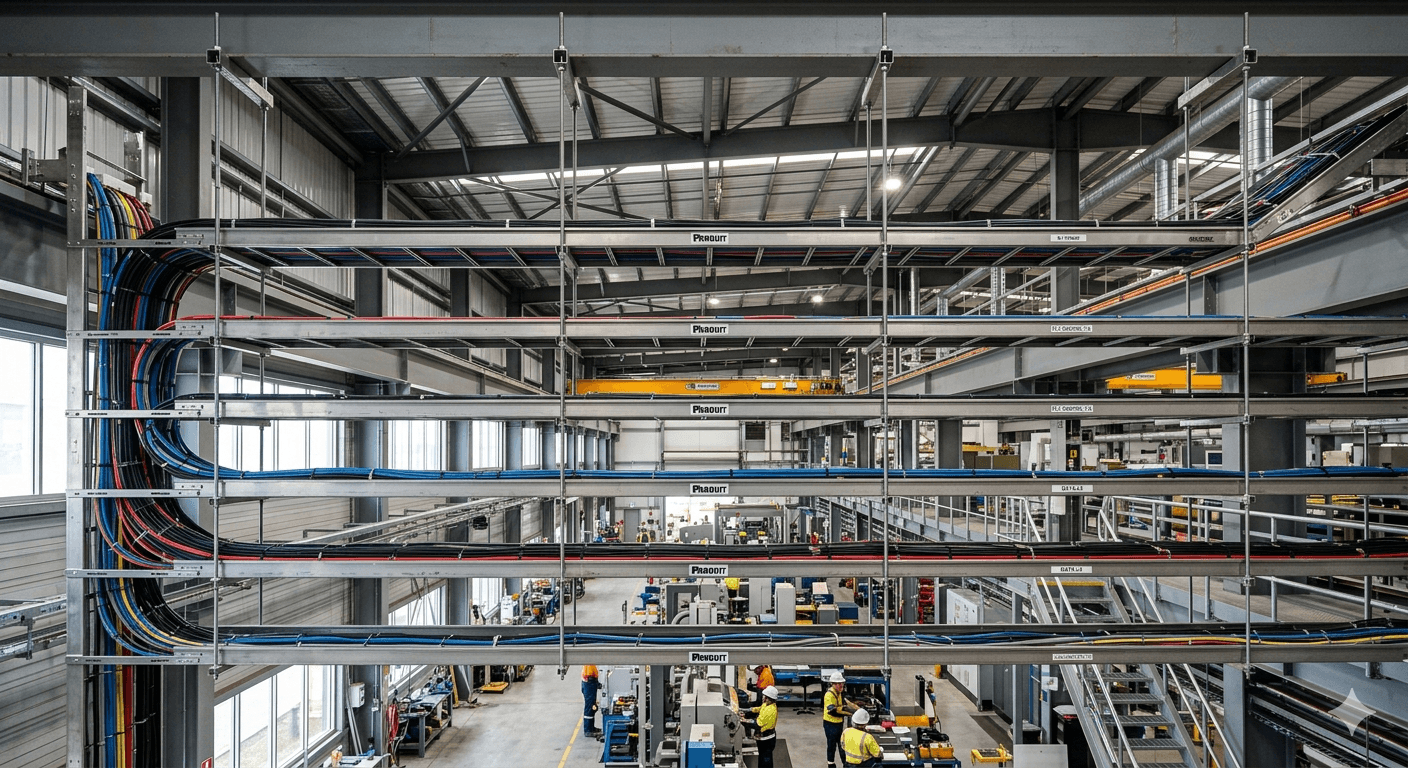
Bus Duct Systems
Bus Duct Systems
High-capacity aluminum and copper duct systems for efficient power distribution in modern industrial and commercial complexes
Two Essential Distribution Solutions
Bus Tie Duct Systems
Bus Tie Duct Systems
Flexible aluminum or copper bus duct systems designed for interconnecting multiple power sources or load centers with high current capacity. Ideal for dual-generator systems, parallel transformer feeds, or interconnecting adjacent substations with minimal voltage drop.
Technical Specifications
Bus Way Distribution Systems
Bus Way Distribution Systems
Modular series of enclosed bus bars running through industrial buildings for distribution to multiple branch circuits and equipment. Superior to cable for high-density power delivery with lower impedance, fan-mounting capability, and future expansion flexibility.
Technical Specifications
Key Advantages
Superior to traditional cable and conduit systems
Ultra-Low Impedance
Parallel conductor paths minimize voltage drop over distance, enabling long-distance power distribution with minimal energy loss
Quick Installation
Modular design and direct bolted connections eliminate complex cable routing and junction boxes, reducing labor and commissioning time
Future Expandability
Add outlets and branch circuits along the main duct run without breaking existing connections or rerouting power
Superior Heat Dissipation
Open housing design and aluminum construction allow ambient air to cool conductors, maintaining safe operating temperatures
Cost Optimization
Eliminate expensive cable trays, conduit systems, and redundant cable runs while reducing installation labor significantly
Enhanced Safety
Fully enclosed isolated bus bars prevent accidental contact with live conductors and reduce arc flash hazards
Why Bus Duct Wins
| Criteria | Bus Duct System | Cable + Tray | Conduit System |
|---|---|---|---|
| Voltage Drop | Minimal (<2%) | Moderate (3–5%) | High (5–8%) |
| Installation Time | ✓ Fastest | Moderate | Slow |
| Space Occupied | Compact | Large tray & trench | Distributed routing |
| Future Expansion | ✓ Trivial | Rework cables | Replace conduit |
| Operating Cost | ✓ Lowest | Moderate | Higher cooling load |
| Maintenance Access | ✓ Direct outlets | Cable routing review | Wire pulling needed |
Where Bus Duct Excels
Multi-Level Factory
Interconnect main transformer (ground floor) to sub-stations on each production level with minimal voltage drop and maximum scalability
Commercial High-Rise
Vertical bus run through elevator shaft serving electrical rooms on each floor with future tenant modifications simplified
Industrial Complex
Ring main distribution connecting multiple process buildings with dual-fed changeover and load balancing
Data Centers
High-density server room power distribution with granular circuit control and thermal management
Hospital Campuses
Campus-wide low-voltage feeds to distributed medical equipment with critical redundancy
Logistics Hubs
Large warehouse power distribution for conveyor systems, freezers, and automated material handling
Lower TCO & Faster ROI
40% Faster Installation
Modular bolt-together design eliminates cable routing, termination, and testing labor—saves weeks on large projects
Energy Efficiency Gains
Lower impedance = less resistive loss over distance. In large facilities, pays for itself through reduced energy waste
Reduced HVAC Load
Better thermal performance with aluminum housing allows lower ambient cooling, reducing facility climate control costs
Typical 5-Year Savings
Installation & Labor
₨800,000–1.2M
Energy (Voltage Drop Loss)
₨400,000–600K
Maintenance Reduction
₨150,000–250K
TOTAL 5-YEAR BENEFIT
₨1.35–2.05 Million
Design Your Bus Duct System
Get a feasibility assessment and cost comparison for your facility
Schedule Engineering Review